Matching brand trust scores to real reputational signals without manual review wastes time and misses context in fast-moving markets. Most brand trust scoring software relies on basic review counts or allows brands to influence scores through paid placements, which skews results. The comparison shows which options offer independent, transparent scoring and reporting so marketing teams can pick a system that fits their verification needs.
Table of Contents
- Verify
- Reputation.com
- BrandMentions
- Crowlingo
- TrustEdge Social Listening Dashboard
- Stalkr
- Comparison of alternatives
Verify
At a Glance
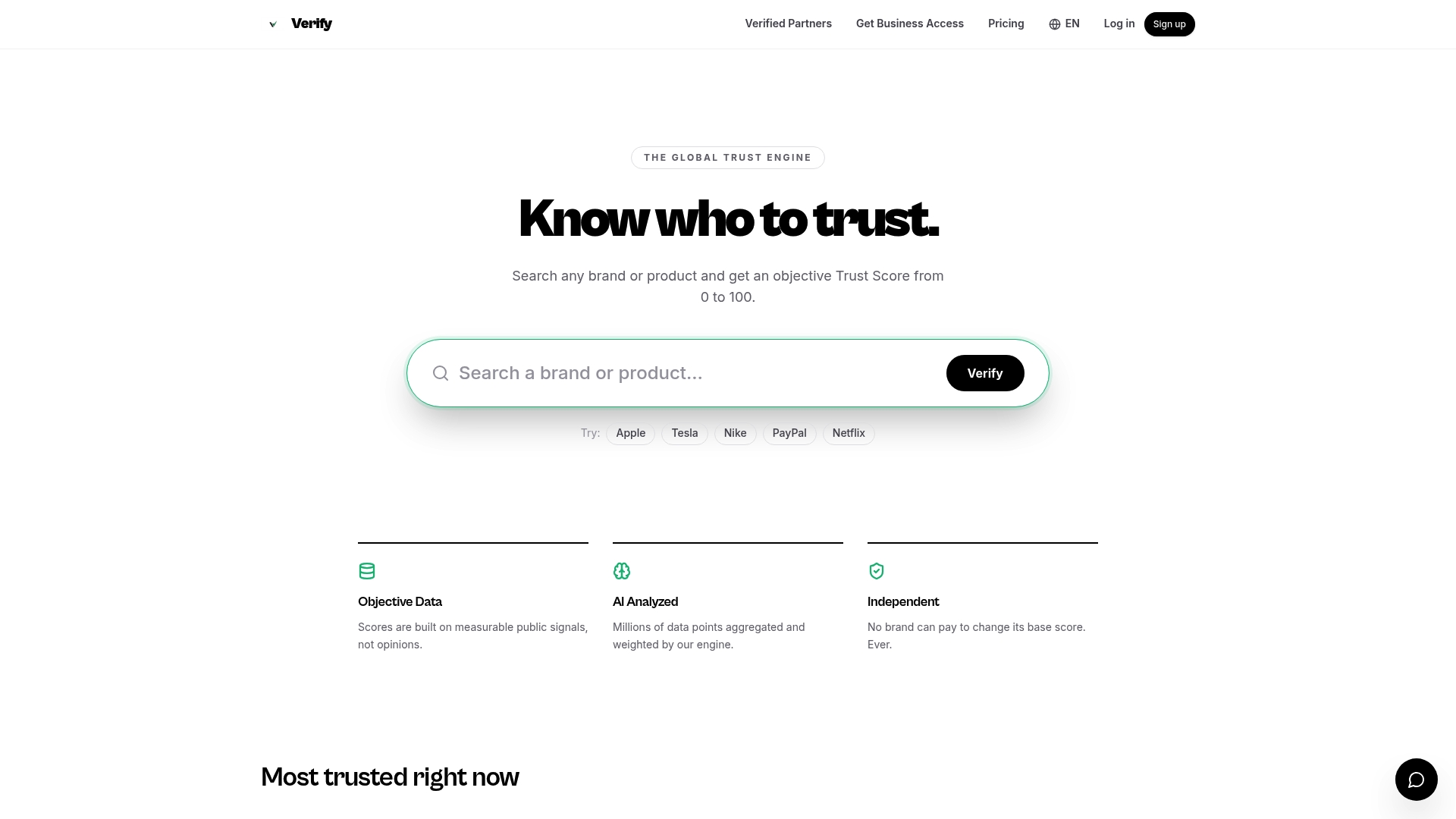
Assigns an objective Trust Score on a 0 to 100 scale for any brand or product. The score is meant to reflect measurable public signals rather than promotional claims. Verify offers a free base score and a paid route for deeper certification and reporting.
Core Features
Verify calculates an objective Trust Score and publishes it alongside a visible certification badge for brands. Its engine uses AI to analyze signals pulled from public sources and generates a written trust assessment. Premium accounts can request a detailed 20-page trust analysis report to attach to a brand listing.
Key Differentiator
Independent scoring that disallows paid influence on base scores. Verify emphasizes that brands cannot pay to inflate their Trust Score. The vendor advertises the platform as relying on public signals and AI analysis to keep evaluations neutral.
Pros
Provides a clear, numerically scaled trust signal that people can scan quickly. The independence policy removes a common conflict of interest and makes the published score easier to defend when communicating with customers. The visible Verify Certified badge and the option for a 20-page trust analysis report let companies present documentation alongside the score. The combination of a free base score and a paid certification path fits both casual shoppers and companies that need formal verification.
Cons
- Free base scores give limited detail, so full context requires the premium analysis.
Who It's For
Companies that want a public, verifiable marker of transparency to show customers and partners. Consumers who want a compact trust signal before making buying decisions will find the numeric score useful. Business buyers conducting B2B checks can reference the certification badge and any attached report when comparing vendors.
Unique Value Proposition
The Verify Certified badge links a brand listing to a published, vendor-backed trust report, giving companies a shareable trust asset. That report serves as more than a badge because it provides a writeup buyers can read while evaluating a supplier. Verify charges for the deeper analysis, which lets smaller brands choose either a simple public score or a documented certification package.
Real World Use Case
A tech startup applies for the Verify Certified badge and posts the attached 20-page analysis on its website to reassure early customers. A shopper compares two competing peripherals and favors the one with a higher Trust Score and a certification badge. Procurement teams use the score and the published report as part of vendor due diligence.
Website: https://verifyproject.it
Reputation.com
At a Glance
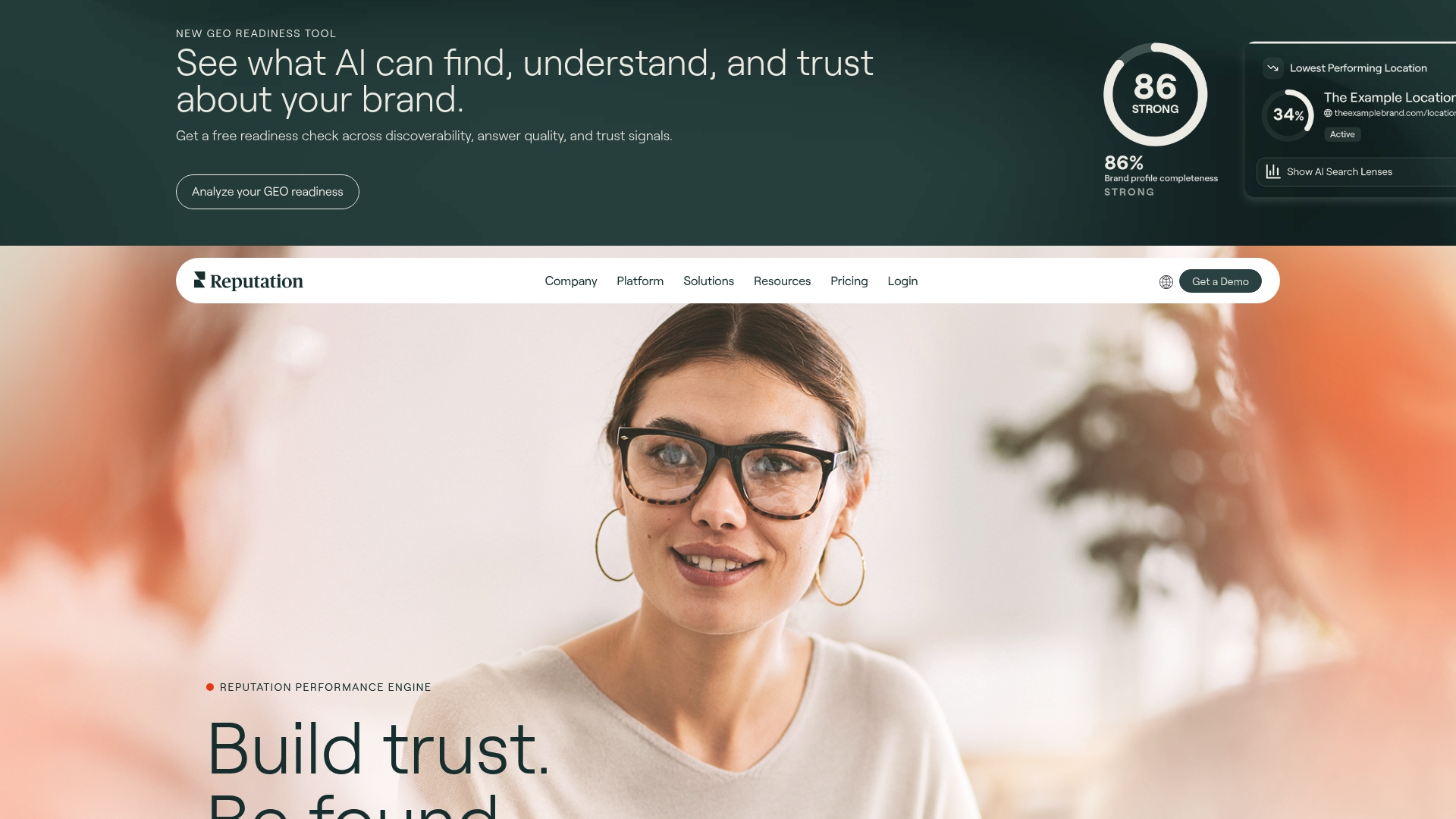
Starting at $80 per location per month, Reputation.com uses pricing by location for its core plan. The product targets brands that operate many sites and need local visibility and reputation control. Kia UK used the platform for reviews, listings, and surveys to raise ratings and customer engagement.
Core Features
The platform centralizes reviews, listings, surveys, and social signals, and analyzes them with AI to produce recommendations. It automates review collection and responses, manages local SEO listings, and routes actions for issue resolution. Dashboards show a consolidated reputation score KPI, performance across locations, and custom reports for teams.
Key Differentiator
The product positions itself as an AI native system that converts scattered reputation signals into prioritized work for local teams. It ties those signals to measurable KPIs so regional managers see clear next steps. That focus on signal to task mapping suits organizations that must coordinate many locations.
Pros
The platform brings reviews, local listings, surveys, social publishing, listening, and issue routing into one place. It applies AI analysis and recommendations to prioritize local work and the consolidated reputation score KPI makes tracking easier. Vendor materials offer free brand analysis reports and pricing tiers that scale from small deployments to enterprise rollouts.
Cons
-
Some users report a steep learning curve and require training to use the system effectively.
-
Costs can be high for single locations or very small businesses.
-
Implementation and customization often need dedicated support, which can increase total project cost.
When It May Not Fit
If you operate a single location or run a very small business, the platform may feel complex and costly. Teams that only need basic review posting and a simple inbox will likely prefer lower cost tools. Organizations without in house implementation capacity should expect extra expenses for setup and customization.
Who It's For
Brands with multiple locations that must manage local search visibility and consistent customer experience will get the most value. Marketing and local operations teams that need a single source of reputation truth will find the workflows useful. Enterprises and franchise networks that require scale and cross location reporting match this product profile.
Real World Use Case
Kia UK used the platform to centralize reviews, surveys, and listing management across locations. That work led to higher ratings and stronger customer engagement, according to the company. The example shows how coordinating location level efforts can lift average scores and response rates.
Pricing
Pricing starts at $80 per location per month for the core plan. Advanced plans and enterprise options are available by request for larger rollouts. Total cost will depend on number of locations and required implementation services.
Website: https://reputation.com
BrandMentions
At a Glance
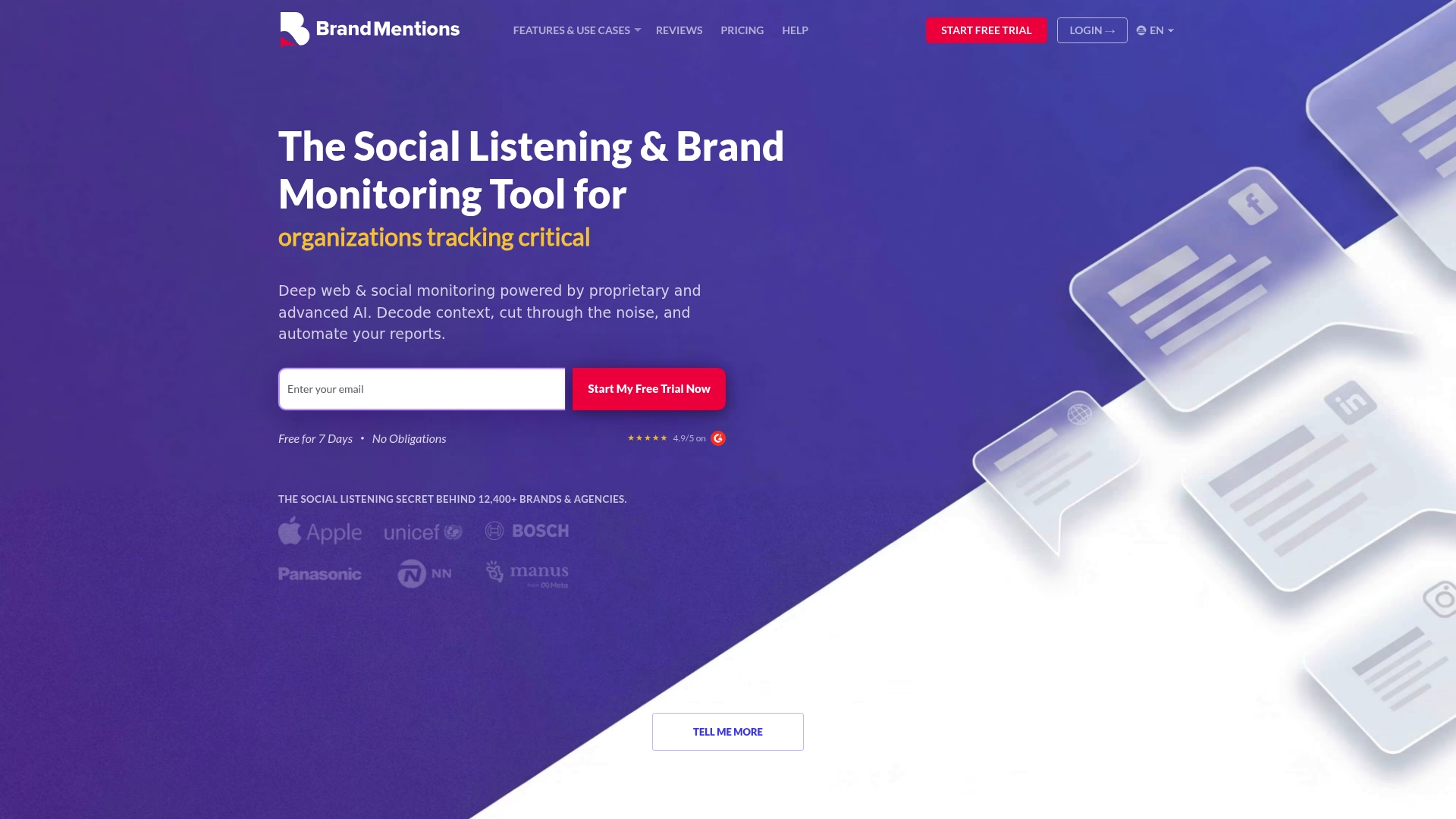
BrandMentions reports it is used by thousands of brands, agencies, and companies worldwide. The platform collects mentions across web and social media and delivers real time alerts and mention analytics. Its dashboard highlights sentiment tagging, influencer leads, and hashtag tracking for quick triage and follow up.
Core Features
BrandMentions monitors social networks, news sites, blogs, videos, and forums and groups those mentions into searchable streams. The platform sends real time alerts and provides mention-level analytics including sentiment analysis and influencer identification so teams can prioritize outreach. It also offers competitor spying and basic business intelligence for spotting share of voice and content gaps.
Key Differentiator
The vendor positions its AI powered decoding and relevance filtering as the feature that narrows noise and surfaces higher quality mentions. That claim focuses on reducing false positives and grouping context so analysts spend less time sifting raw results. The approach favors depth of signal over simple volume counting.
Pros
User reviews frequently cite the tool's wide coverage of global sources and its ability to surface mentions others miss. Fast, real time notifications let teams respond to negative sentiment or PR opportunities quickly. The vendor also highlights accuracy in mention relevance and notes easy integration into existing marketing workflows, which helps teams move from alert to action without heavy manual steps.
Cons
-
Data privacy considerations depend on how you configure and export streams, so legal review may be required.
-
Advanced features carry a learning curve; analysts will need time to tune filters and alerts.
-
Large volumes of raw mentions can be overwhelming unless you build disciplined dashboards and labeling.
When It May Not Fit
This product is not a good match for teams that want only shallow, headline level mention counts without deep analysis. Smaller teams without someone assigned to refine rules and dashboards will see noise grow quickly. Organizations that cannot dedicate time to training and customization should consider simpler alert tools instead.
Who It's For
Marketing teams, PR professionals, brand managers, and social media managers who need in depth tracking will get the most value. Agencies that monitor multiple client brands will benefit from the global coverage and competitor spying features. This tool suits teams prepared to invest time in tuning filters and dashboards for accurate results.
Real World Use Case
A marketing agency uses BrandMentions to watch client mentions across regions, tag negative sentiment, and surface influencer partnership leads. The team routes urgent alerts to account leads and compiles influencer lists for outreach. That workflow shortens response time and grows coverage for the clients the agency manages.
Pricing
Plans start with a 7-day free trial and pricing details are listed on the vendor website. The vendor frames its plans as suitable for small and mid size businesses up to large enterprises, with tiered features and limits described online.
Website: https://brandmentions.com
Crowlingo
At a Glance
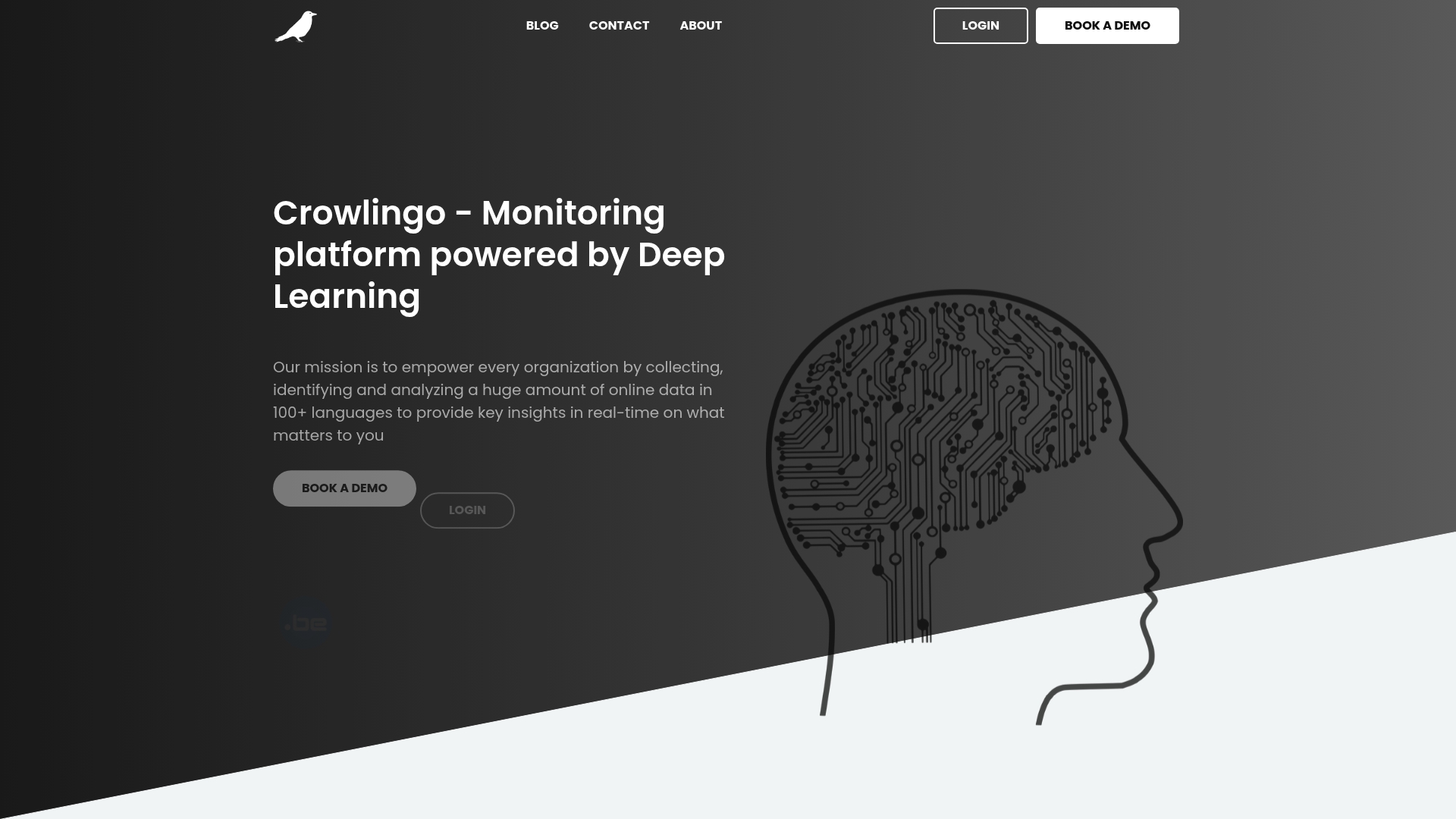
Support for more than 100 languages is a capability the vendor highlights for wide geographic coverage. Crowlingo pairs that language coverage with real time monitoring across social media, online press, forums, and custom sources. The platform advertises automatic alerts and quick report creation to shorten response times for reputational events.
Core Features
Crowlingo collects online data in real time from social networks, news sites, forums, and user defined feeds. It applies deep learning based sentiment and hatefulness analysis and unifies multilingual text for consistent processing. The product also offers automatic alerts, one click report creation, and custom data ingestion via APIs, CSV, or JSON.
Key Differentiator
The vendor emphasizes deep learning that it says enables more nuanced concept and sentiment detection across its claimed language coverage. That capability is paired with real time alerts tuned to organizational criteria. The combination aims to let analysts spot emerging issues faster than simple keyword tracking alone.
Pros
Crowlingo supports multilingual analysis, which helps teams that track reputation across markets and languages. Real time alerts and quick report exports reduce the lag between signal detection and response. Flexible ingestion options, including APIs and file imports, let analysts add proprietary feeds or local sources. Personalized onboarding and modular features let organizations tailor the setup to specific monitoring needs.
Cons
- Third party reviews point to a steep learning curve and a cluttered interface for new users.
- Public information about pricing and scalability is limited, which makes budgeting harder.
- Smaller teams without technical support may struggle to manage custom integrations and advanced configurations.
When It May Not Fit
Organizations that need a highly polished, plug and play dashboard may find the interface challenging. Teams that require transparent, published pricing will need to contact the vendor or look elsewhere. Small operations without engineering support could find custom source setup and advanced tuning resource intensive.
Notable Integrations
- APIs for custom data source ingestion, enabling programmatic feeds and bespoke connectors.
- CSV and JSON imports for batch uploads from legacy systems or data exports.
Who It's For
Global organizations seeking multilingual online data monitoring and brand reputation management will get the most value. Communications and crisis teams that must monitor press and social channels across multiple countries fit well. Market research teams that need unified, language agnostic sentiment signals will also benefit.
Real World Use Case
A multinational corporation uses Crowlingo to monitor social discussion and press coverage across multiple countries. Analysts receive alerts when sentiment drops or when concepts spike in certain markets. That workflow helps communications teams respond quickly to localized issues before escalation.
Pricing
Pricing is not publicly listed. The product entry lists pricing as not applicable and informational only, so expect custom quotes or a sales conversation for licensing details. Organizations should request a detailed proposal to learn about tiers, limits, and implementation fees.
Website: https://crowlingo.com
TrustEdge Social Listening Dashboard
At a Glance
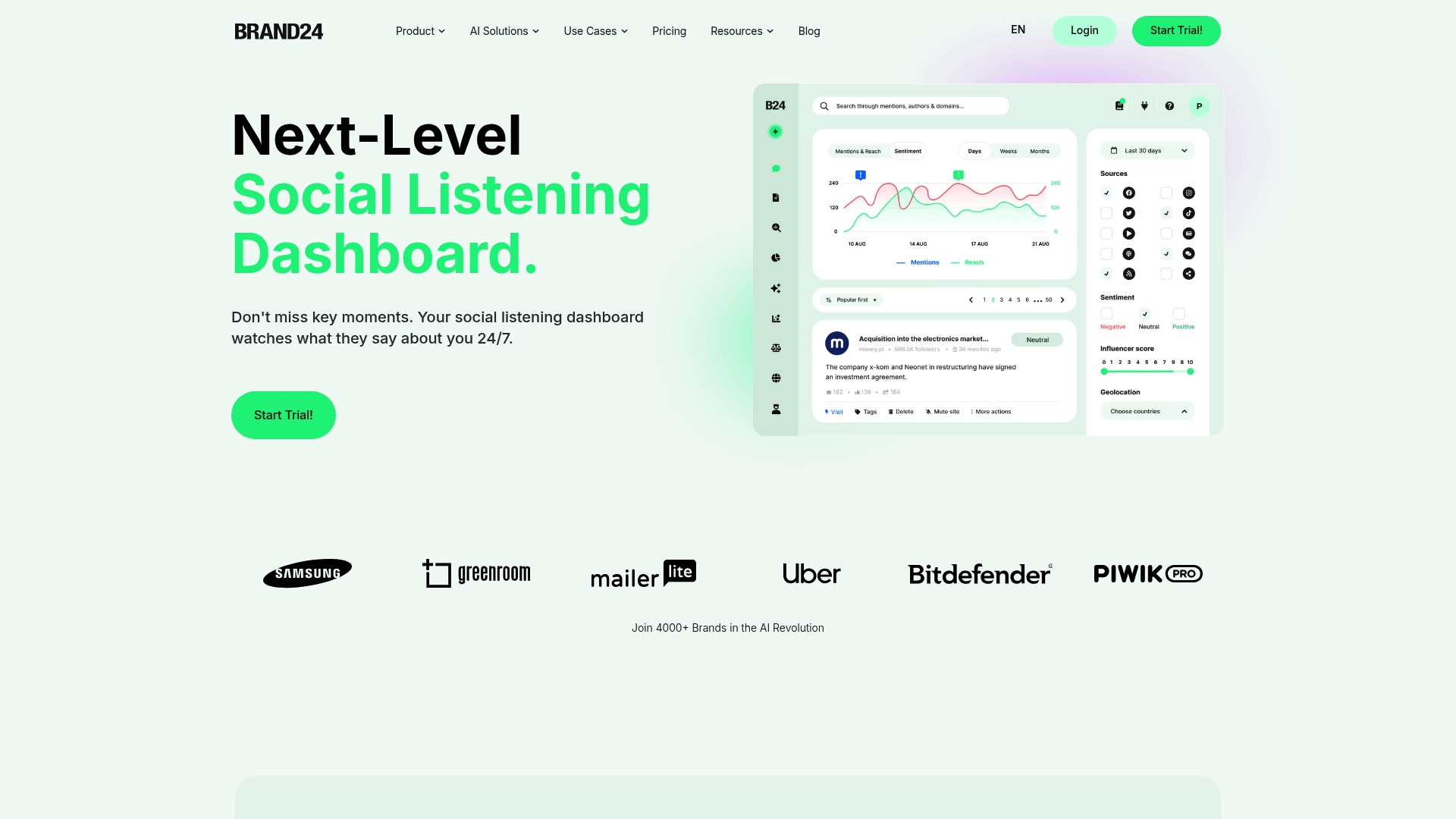
TrustEdge reports real time mention tracking across 25 million channels. The vendor advertises it is used by more than 4,000 brands, which signals enterprise adoption. The dashboard focuses on sentiment and emotion detection to surface spikes and reputational risks quickly.
Core Features
TrustEdge collects mentions from social media, news sites, blogs, forums, and other public sources and displays them in a single dashboard. The platform pairs that stream with AI powered sentiment and emotion analysis and smart filters by sentiment, influence, platform, location, and keywords. Users can set instant alerts for mention spikes and export branded reports in PDF, Excel, or PowerPoint formats for stakeholders.
Key Differentiator
TrustEdge combines broad reach with emotional signal detection to flag not only negative mentions but the emotional tone behind them. That blend of scale and emotion analysis helps teams prioritize responses by the likely audience reaction rather than raw mention volume. The product aims to reduce time spent sorting noise and to speed up PR response windows.
Pros
The interface offers a clear view of mention flows and lets teams apply smart filters to find relevant conversations fast. Real time alerts let PR and social teams react before issues escalate, and the reporting output supports regular stakeholder updates. The emotion detection adds nuance to sentiment tags, which helps when simple positive negative labels miss context. Custom report templates support white labeling for agency reporting.
Cons
- Social channels only: organizations that do not rely on social or online mentions will see limited value.
- Overkill for very small teams: the extensive feature set can overwhelm users needing only basic tracking.
- Data volume costs: handling very large volumes may affect performance and could require a higher plan.
- Customization learning curve: deeper tailoring often needs onboarding or support to get optimal results.
When It May Not Fit
If your communications workflow does not use social channels, TrustEdge will add little. Small brands with a single social account and a tight budget may find the feature set disproportionate. Teams that need competitor benchmarking features not listed on the product pages should verify those needs before committing.
Who It's For
Enterprise marketing and PR teams, digital agencies, and brand managers who need wide coverage and emotional context will get the most from TrustEdge. Organizations that publish frequent reports for executives or clients benefit from the branded export options. Buyers who prefer minimal tooling will likely find a lighter monitoring product more suitable.
Real World Use Case
A global consumer electronics brand used TrustEdge to scan social media, news, and forums for a product launch. The team received an alert for a negative thread and used emotion analysis to confirm high concern, then routed a rapid statement through PR and reduced potential escalation. The reporting module turned monitoring data into a slide deck for the executive review.
Pricing
Pricing details are published on the official site and the vendor offers tailored plans based on enterprise needs. Expect customized quotes for higher data volumes and advanced feature requests. Prospective buyers should contact sales for plan and volume details.
Website: https://brand24.com/social-listening-dashboard
Stalkr
At a Glance
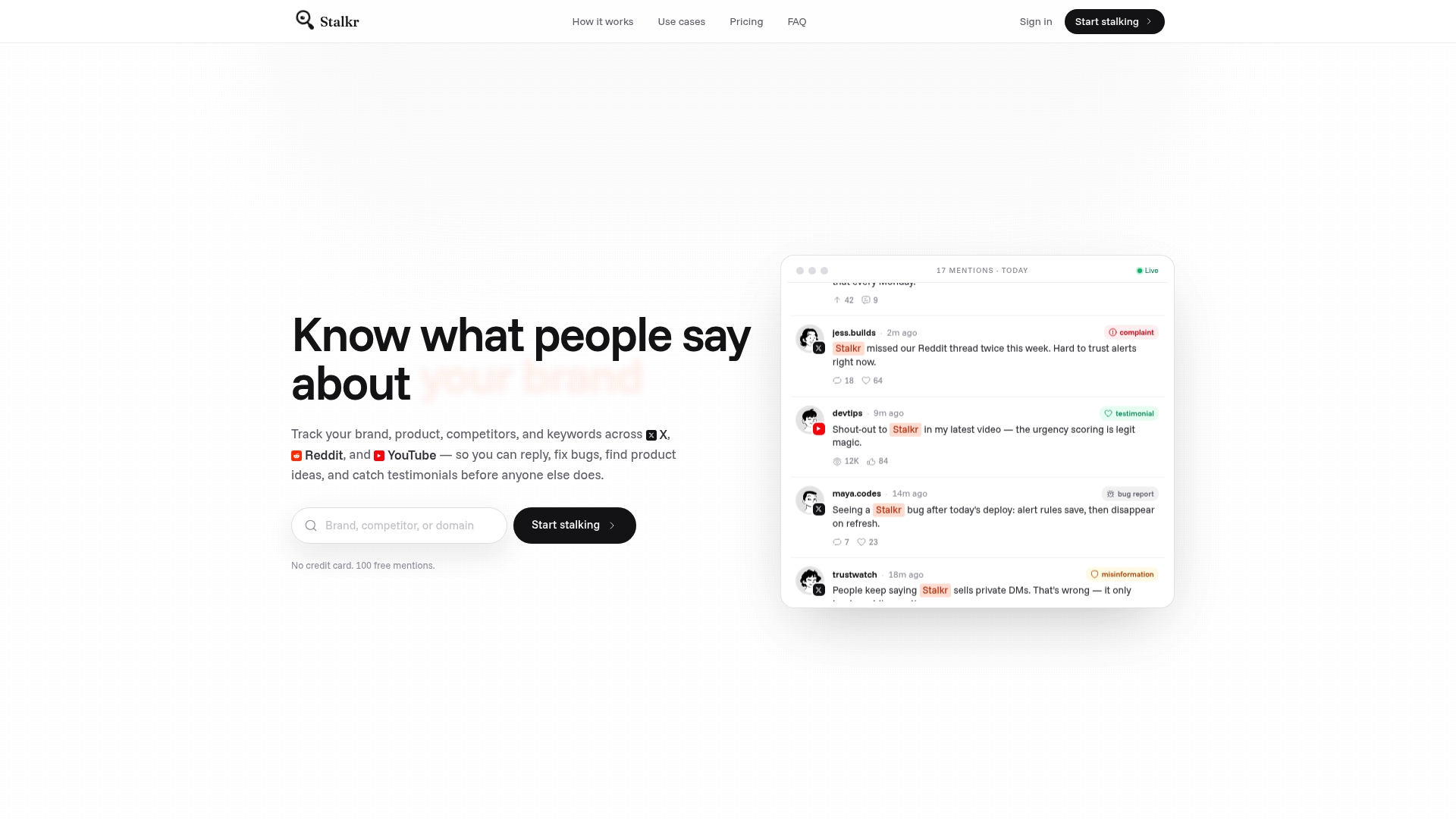
Stalkr captures public mentions across X, Reddit, and YouTube without requiring any manual tagging. The tool applies AI to sort those mentions into categories like bugs, testimonials, and misinformation. Email alerts highlight high priority posts, so teams can act quickly.
Core Features
Stalkr focuses on targeted listening with keyword monitoring across major public platforms and a sentiment and urgency ranking that surfaces mentions that matter. The product groups signals into custom categories and offers saved views for recurring filters or reports. Email alerts flag high priority items for members who need to respond fast.
Key Differentiator
Stalkr stands out for arranging public social posts into usable categories without any manual tagging. That approach reduces time spent on setup and helps members spot product issues, customer praise, or misinformation quickly. The live sorting into categories keeps review queues shorter for small teams.
Pros
Stalkr tracks public conversations without manual tagging, which saves time during launches and incident responses. Its AI organization places mentions into categories such as bugs, testimonials, and misinformation so members can triage work by intent. Saved views and email alerts support recurring monitoring workflows and help marketing or support members convert praise into testimonials or escalate complaints.
Cons
- The vendor states a 100 free mention limit before upgrading, which can restrict exploratory use by smaller teams.
- Email alerts can be delayed or unreliable according to third-party reviews, causing missed or late notifications.
- Some users report mention duplication and limitations in saved views, which adds cleanup work for moderators.
- Integrations are limited and the product primarily focuses on social listening rather than connecting to broader tool chains.
When It May Not Fit
Stalkr may not suit teams that need guaranteed, real-time paging workflows because alerts can arrive late. Organizations that require deep integrations with CRMs or ticketing systems will find the integration set limited. If your community monitoring extends beyond public social posts into private channels, this offering will feel narrow.
Who It's For
Startups, solo founders, product teams, and agencies that need focused social signals will get the most value from Stalkr. Members who prioritize quick triage of public complaints or who want to collect testimonials from X, Reddit, and YouTube can adopt it without lengthy setup. Larger organizations that require broad toolchain integration may outgrow it.
Real World Use Case
A SaaS startup used Stalkr during a product launch to catch early Reddit complaints and tweets. Members flagged recurring bug reports, routed them to the product channel, and turned positive posts into marketing quotes. That workflow reduced public escalation and generated usable testimonials for the launch page.
Website: https://stalkr.ai
Comparison of alternatives
Among reputation monitoring tools, various approaches serve distinct needs, with Verify excelling in providing independent, AI-driven trust evaluations.
Trust scoring vs. reputation management
Verify distinguishes itself by offering numerically defined trust scores openly visible to consumers, unaffected by paid influences. This independent system provides businesses with a verifiable trust metric connected to in-depth analysis reports. Conversely, Reputation.com focuses on multi-location reputation management, offering centralized control over reviews, surveys, and local SEO elements. This caters to large, geographically diverse organizations but may overwhelm smaller entities due to its complexity and cost.
Multilingual analysis and global monitoring
Crowlingo stands out for its ability to analyze content across over 100 languages, leveraging deep learning to standardize sentiment detection. For brands targeting global markets or tracking their reputation in multiple languages, this feature provides a crucial advantage. However, the platform's lack of transparent pricing may deter businesses requiring clear cost analysis. Stalkr, by contrast, provides streamlined public mention tracking across specific platforms but maintains limited integration options, better tailoring its solution to single-purpose monitoring needs.
Best fit
- Businesses prioritizing public transparency and consumer confidence will benefit most from Verify's independent Trust Score and certification badge.
- Enterprises managing numerous local offices or franchises should consider Reputation.com for its advanced local SEO and multi-location reporting features.
- Marketing agencies and social media teams seeking in-depth analytics and influencer tracking will find BrandMentions valuable for its global sentiment monitoring and competitor spying tools.
- Organizations requiring multilingual reputational analysis and customized data ingestion will benefit from Crowlingo's extensive language support and versatility.
Our pick
Verify is our top choice for businesses seeking a transparent, verifiable trust rating to enhance customer confidence in their brand. Its unique independent scoring model ensures unbiased trust evaluations, supporting businesses aiming to establish or reinforce their reputation. Organizations, however, requiring advanced local SEO management or multilingual capabilities might find other tools in this comparison more suitable.
To help you decide on the most effective brand reputation monitoring platform, consider the key features and unique capabilities of these top solutions.
| Product | Core Feature | Key Differentiator | Best For | Pricing | Notable Limitation |
|---|---|---|---|---|---|
| Verifyproject | Objective Trust Score on 0–100 scale | Neutral scoring, independent analysis | Companies and consumers needing trust certification. | Price not published | Free score limits detail; premium needed for details |
| Reputation.com | Centralized reputation platform | AI-driven KPI and task prioritization | Brands managing repetitive, large-scale customer sites | $80 per location/month | High complexity, requiring learning and setup |
| BrandMentions | Mention analytics and sentiment tagging | AI filters reduce false positives | Marketing teams seeking global mention coverage | Tiered, see website | Overwhelming for smaller teams |
| Crowlingo | Multilingual monitoring and sentiment | Deep learning for nuanced detection | Global organizations requiring multilingual tracking | Price not published | Complex implementation and limited public pricing |
| Stalkr | Social post triage and alerts | Auto-categorizes mentions | Startups focusing on public complaints and feedback | Plans beginning as free | Alerts may have delays, limiting urgency response |
How Can You Find a Trustworthy Reputation Monitoring Tool?
Reputation monitoring tools often overwhelm teams with complex data or lack truly unbiased trust signals. Many businesses and consumers struggle to identify transparent, verifiable brand scores free from hidden influence or promotional bias. Verifyproject offers a clear solution by providing an objective Trust Score ranging from 0 to 100 based solely on measurable public signals. This ensures companies and consumers receive honest evaluations backed by AI analysis without interference.
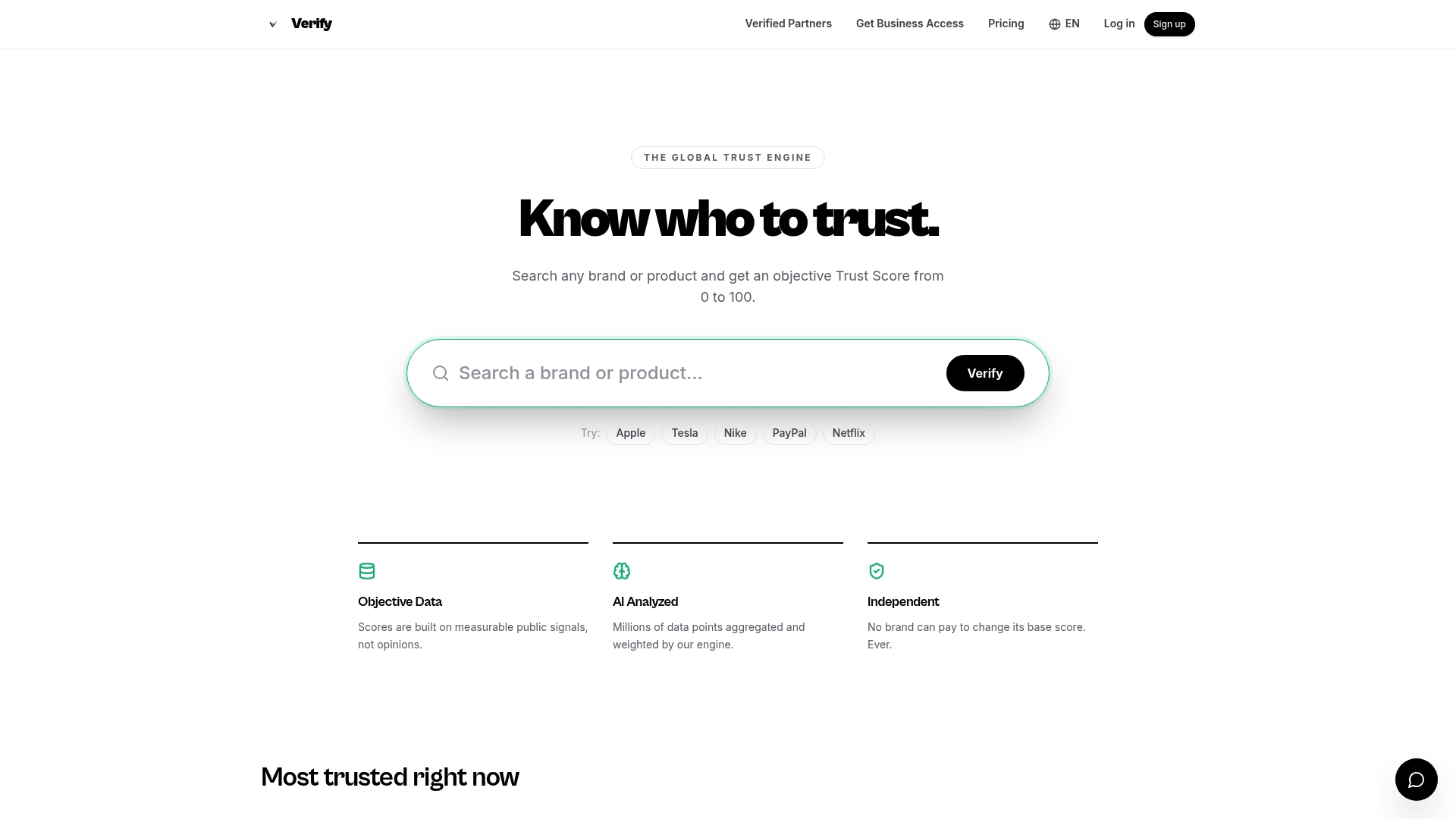
Choose Verifyproject to access your free base trust score or upgrade for a detailed certification report. Whether you are a business seeking transparency or a consumer comparing product reliability, Verifyproject helps you make confident decisions. Visit Verifyproject now and start viewing trustworthy brand ratings today.
FAQ
How does Verifyproject determine its Trust Score?
Verifyproject calculates its Trust Score based on measurable public signals rather than promotional claims. The platform uses AI to analyze data pulled from public sources, resulting in an objective score displayed alongside a certification badge. Starting with a clear Trust Score allows brands to convey transparency effectively.
What is the difference between Verifyproject and Reputation.com?
Reputation.com excels at managing local visibility and reputation control for businesses with many locations. Verifyproject focuses on independent scoring that is not influenced by paid promotions, offering a free base score and premium certification. Enterprises with multiple locations may find Reputation.com more suited to their needs.
Can I expect detailed reports with Verifyproject's premium plan?
Yes, Verifyproject offers a premium account that includes a detailed 20-page trust analysis report. This report can be attached to brand listings, providing additional context and documentation to users seeking formal verification, making it a useful asset for companies.
Does Verifyproject support multiple brands under one account?
Verifyproject is primarily designed for individual brand trust scoring. Companies with multiple brands may need to create separate listings for each. This approach ensures that each brand receives an accurate and tailored Trust Score, enhancing transparency and individual accountability.
How quickly can I see results after signing up for Verifyproject?
Users can access Verifyproject's free base score shortly after signing up. This immediate availability allows brands to showcase their trustworthiness right away, while the premium certification analysis takes additional time to prepare, providing deeper insights into brand trust.