
A legitimate online store is defined by three verifiable qualities: a traceable identity, secure data handling, and a real customer service presence. Knowing how to check if an online store is legit before you buy protects you from losing money to scams that look increasingly convincing. Fraudulent sites now mimic real retailers with professional layouts, copied product photos, and even valid security certificates. The good news is that a layered verification process, combining domain checks, contact tests, policy analysis, and third-party reputation research, consistently exposes fake stores before you hand over your credit card number.
How to check if an online store is legit using domain data
The domain registration record is the first place to look when you want to verify online store authenticity. Every domain has a public WHOIS record that shows when it was registered, who owns it, and where the registrar is located. You can run a free WHOIS lookup at ICANN's official lookup tool or through registrar sites like GoDaddy.
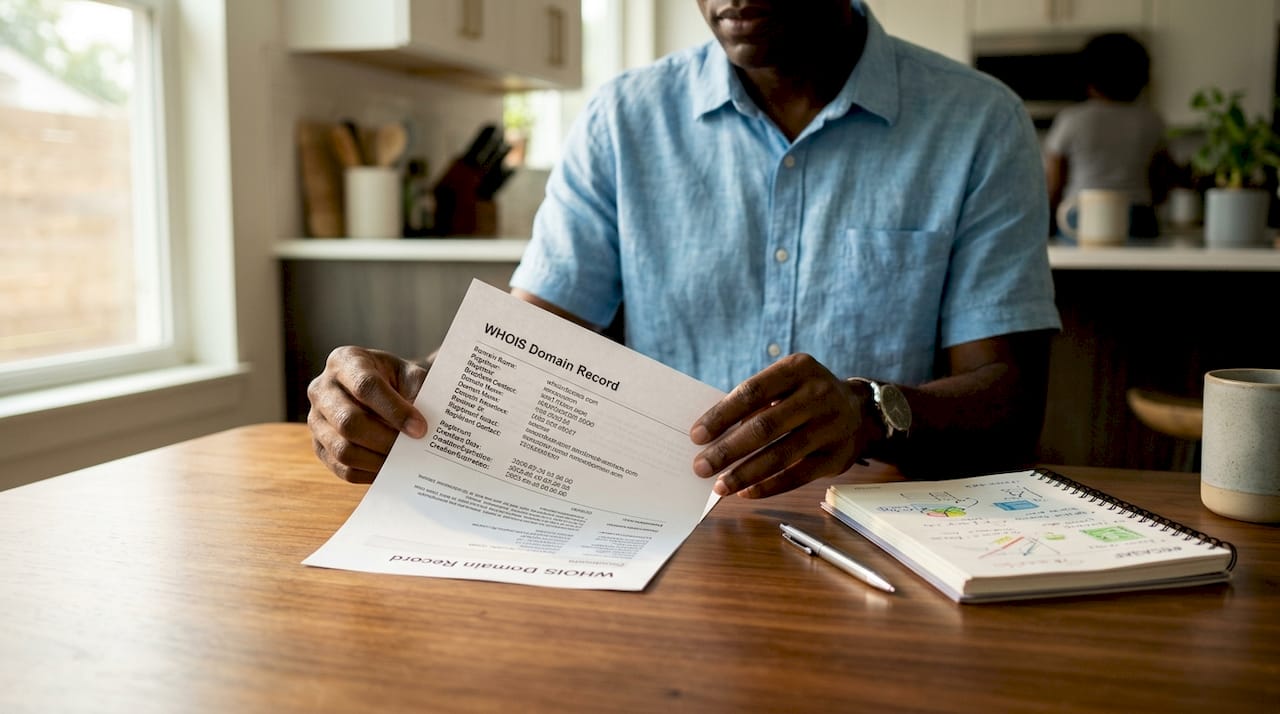
Pay close attention to domain age. Domains registered less than 6 months ago are a high-risk indicator for scam sites. Scammers spin up new domains quickly, run a fraud campaign, then abandon the site before complaints pile up. A store claiming to have been in business for years but with a domain created three months ago is a direct contradiction worth taking seriously.
Watch for these red flags in WHOIS results:
- Anonymized ownership: Privacy protection on a personal blog is normal. On a store asking for your payment details, it removes accountability entirely.
- Registrar location mismatch: A store claiming to be based in Chicago but registered through an obscure overseas registrar is suspicious.
- Domain name variations: Scammers register names like "amaz0n-deals.shop" or "nikeoutlet-us.net" to mimic trusted brands. This tactic is called typosquatting.
- Very short registration period: Legitimate businesses typically register domains for multiple years. A one-year registration on a new site suggests low commitment.
Pro Tip: Copy the store's domain name and paste it into ICANN's WHOIS lookup at lookup.icann.org. Check the "Creation Date" field first. If the site is less than six months old and is selling high-demand products at steep discounts, walk away.
Which signs indicate a fake online store in the website content?
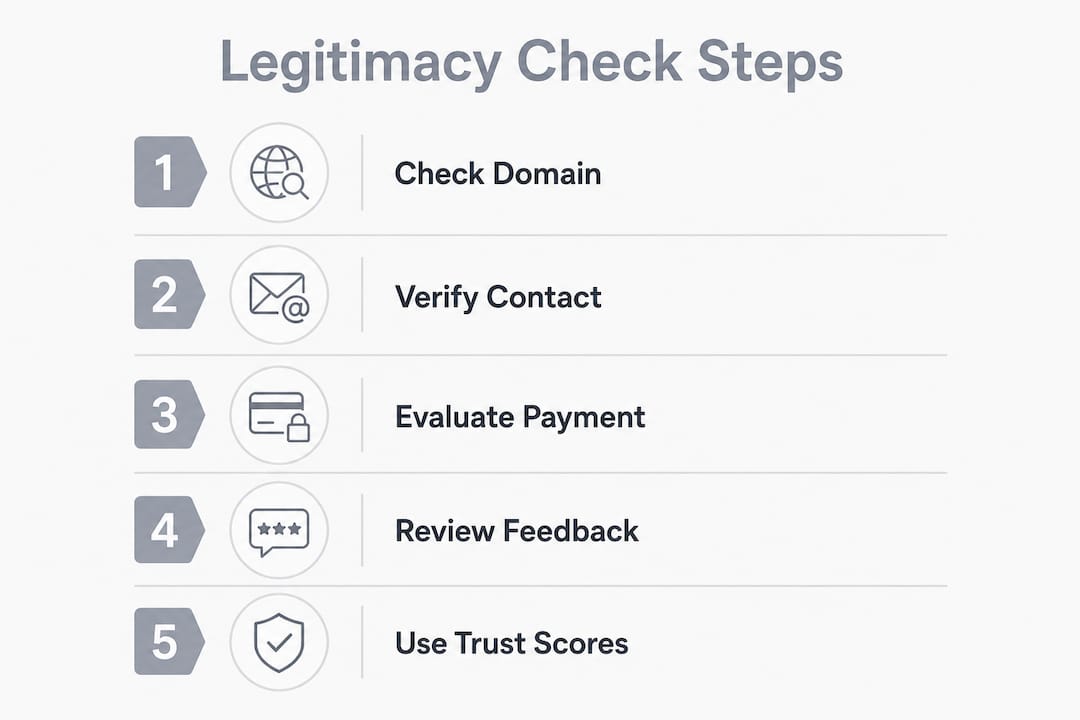
Website content quality is one of the fastest ways to identify fake shopping websites. Spelling mistakes, grammar errors, and awkward phrasing appear frequently on fraudulent sites because scammers often copy and translate text carelessly or use automated tools to generate product descriptions. A single typo is forgivable. Consistent errors across multiple pages signal a site that was built fast and cheap.
Run through this checklist on any store you are unsure about:
- Read the About Us page. A real business tells a real story. Vague text like "We are a global company dedicated to quality" with no founding date, team names, or location is a warning sign.
- Check the Return and Privacy Policy. Copy a unique sentence from the policy and paste it into Google with quotation marks. Duplicated policy text found on dozens of unrelated sites confirms the store copied its policies from a template or another fraudulent site.
- Inspect the URL carefully. Typosquatting uses URLs nearly identical to genuine brands, swapping letters, adding hyphens, or using unusual extensions like ".shop" or ".xyz" instead of ".com."
- Reverse image search the product photos. Right-click any product image and select "Search image with Google." If the same photo appears on a completely different retailer's site, the store likely stole the image. Fake product photos copied from legitimate retailers are a standard tactic for bogus stores.
- Look for a working search function and real product categories. Scam sites often have broken navigation, dead links, or only a handful of products despite claiming a massive catalog.
How to verify contact information and physical business presence
Real businesses are reachable. A legitimate store provides a verifiable phone number, a professional email on its own domain, and a physical address. An email address at Gmail or Yahoo on a store claiming to be a major retailer is an immediate red flag.
Here is how to test each contact point:
- Call the phone number. Does it ring? Does a real person or a professional voicemail answer? A disconnected number or a personal voicemail greeting means the contact information is fake.
- Send an email. Ask a simple product question. A legitimate store responds within one to two business days with a specific, helpful answer. An automated reply with no follow-up or no reply at all is a warning.
- Search the physical address on Google Maps. Paste the address into Google Maps and switch to Street View. A real retail or warehouse location should look like a business. If the address points to an empty lot, a residential house, or a completely different business, the store is misrepresenting itself.
- Check for a generic contact form only. Some scam sites hide behind a contact form with no phone number or email listed. This removes any direct line of accountability.
Pro Tip: Search the phone number and email address independently on Google. Real businesses have those contact details appear in multiple places online. A number that shows up only on one suspicious site has never been verified by anyone.
Evaluating payment methods and policy transparency
Payment options tell you a great deal about how to know if a shopping site is legit. Credit cards and PayPal both offer chargeback protections, meaning you can dispute a fraudulent charge and recover your money. That protection matters enormously when a store fails to deliver.
Wire transfers, cryptocurrency, and gift cards are preferred by scammers because those payments are irreversible. Once the money leaves your account, it is gone. A store that accepts only these methods, or that pressures you to pay by wire transfer for a "discount," is running a scam.
Follow these steps before entering any payment details:
- Confirm the site uses HTTPS. The padlock icon in your browser confirms an encrypted connection. However, HTTPS alone does not guarantee a store is legitimate. Scammers obtain valid SSL certificates easily. Treat HTTPS as a minimum requirement, not a seal of approval.
- Look for recognized payment logos. Visa, Mastercard, PayPal, and American Express logos in the footer indicate standard payment processing. Absence of these logos is unusual for any serious retailer.
- Read the refund policy in full. A real return policy names specific timeframes, conditions, and a process. A policy that says "all sales final" or provides no return window on a store selling electronics or clothing is a red flag.
Pro Tip: Always pay with a credit card rather than a debit card for online purchases. Credit cards give you stronger dispute rights under the Fair Credit Billing Act, which covers unauthorized or fraudulent charges.
How do I know if an online store is legit based on reviews?
Independent customer reviews are one of the strongest signals of a store's real reputation. Reviews hosted only on the seller's own website are worthless as trust signals because the seller controls what appears. You need third-party sources.
Search for the store's name on Trustpilot, the Better Business Bureau (BBB), and Reddit. These platforms allow unfiltered feedback and are much harder for a scammer to manipulate at scale. Searching the company name combined with words like "scam," "complaint," or "review" on Google surfaces complaints that the store would never highlight itself.
Floods of five-star reviews posted in a short period, or reviews using generic wording like "Great product! Fast shipping!" with no specific details, indicate review manipulation. Real customers describe specific products, mention shipping times, and note any issues they encountered.
| Review signal | What it means |
|---|---|
| Reviews only on the store's own site | No independent verification; treat as unreliable |
| Burst of five-star reviews in one week | Likely purchased or incentivized reviews |
| Generic, short praise with no detail | Pattern consistent with fake testimonials |
| Negative reviews with no seller response | Store does not engage with customer problems |
| Consistent complaints about non-delivery | Strong indicator of a fraudulent operation |
Key Takeaways
A layered verification approach combining domain age checks, contact testing, policy analysis, and third-party review research is the most reliable method to confirm whether an online store is legitimate.
| Point | Details |
|---|---|
| Check domain age first | Domains under 6 months old are high-risk; use ICANN WHOIS to verify. |
| Test all contact points | Call the phone number and email the store before purchasing to confirm real responsiveness. |
| Verify policy originality | Search a unique policy sentence in Google to detect copied text from scam templates. |
| Use only protected payment methods | Pay by credit card or PayPal to retain chargeback rights if the store fails to deliver. |
| Search reviews on independent platforms | Use Trustpilot, BBB, and Reddit; search the store name plus "scam" or "complaint" on Google. |
The uncomfortable truth about "secure" online stores in 2026
The single biggest mistake I see shoppers make is treating the padlock icon as a guarantee. It is not. Scammers exploit valid SSL certificates to make fraudulent sites look identical to real ones in the browser bar. I have reviewed dozens of scam sites that scored perfectly on basic security checks while stealing money from hundreds of buyers.
The second mistake is trusting a site because it looks polished. Professional website templates cost almost nothing in 2026. A scammer can deploy a convincing storefront in a few hours using off-the-shelf tools. Visual quality stopped being a reliable trust signal years ago.
What actually works is the combination of checks described in this guide. No single test is foolproof. A scam site might pass the domain age test if it was set up months in advance. It might have a real phone number that goes unanswered. The pattern across multiple checks is what reveals the truth. When three or four signals point in the wrong direction, the site is almost certainly fraudulent regardless of how professional it looks.
My practical rule: if a deal seems too good to be true and the store is less than a year old with no independent reviews, do not buy. The savings are never worth the risk of losing the entire purchase amount with no recourse.
— Vittorio
Verifyproject makes legitimacy checks faster
Checking every signal manually takes time. Verifyproject aggregates millions of public data points into a single Trust Score from 0 to 100 for any brand or store you search. The score is built from measurable signals and calculated by AI algorithms with no input from the brands being evaluated. No store can pay to improve its base score.
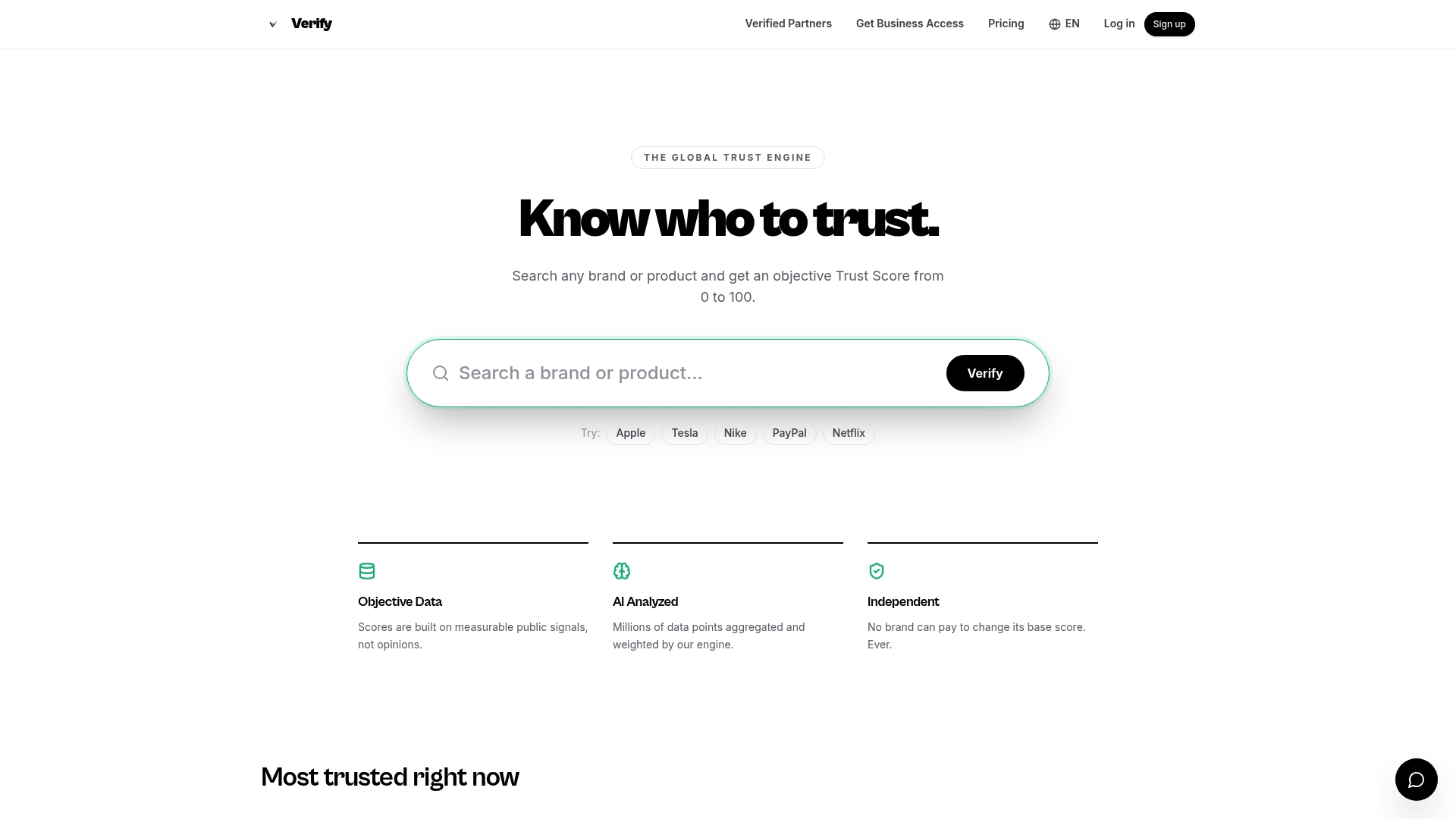
Shoppers who want a fast, unbiased read on a store's credibility can check any store's Trust Score on Verifyproject before buying. Brands that meet the platform's standards earn the "Verify Certified" badge, which signals verified trustworthiness to other shoppers. Companies like Apple and Microsoft score at the top of the scale, giving you a clear benchmark for what a genuinely trusted brand looks like.
FAQ
How can I tell if an online store is legit for free?
Run a free WHOIS lookup on the domain, search the store name plus "scam" on Google, and check Trustpilot or the BBB for independent reviews. These steps cost nothing and take under ten minutes.
Does HTTPS mean a shopping website is safe?
HTTPS confirms the connection between your browser and the site is encrypted, but it does not confirm the store is honest. Scammers obtain valid SSL certificates, so HTTPS is a minimum requirement, not proof of legitimacy.
What payment methods protect me from fake online stores?
Credit cards and PayPal both offer chargeback protections that let you dispute fraudulent charges. Avoid stores that accept only wire transfers, cryptocurrency, or gift cards, since those payments cannot be reversed.
How do I spot fake reviews on a shopping site?
Look for bursts of five-star reviews posted within a short window, generic praise with no product-specific details, and a complete absence of negative feedback. Cross-check on Trustpilot, Reddit, or the BBB for a more accurate picture.
What is typosquatting and why does it matter?
Typosquatting is the practice of registering a domain name nearly identical to a trusted brand, such as "amaz0n-deals.shop," to trick shoppers into thinking they are on a legitimate site. Always verify the exact URL before entering any personal or payment information.