
A company credibility check is the process of independently verifying a business's legal existence, operational history, and trustworthiness before you commit money or a contract. The industry term for this practice is due diligence, and it covers everything from confirming a registration number in a government database to analyzing thousands of customer reviews with AI. Skipping this step is expensive: fraudulent businesses, shell companies, and reputation-laundered vendors cost buyers and partners billions each year. The good news is that official registries, automated trust scoring, and platforms like Verifyproject now make a thorough business credibility assessment achievable in minutes, not days.
What does a company credibility check actually verify?
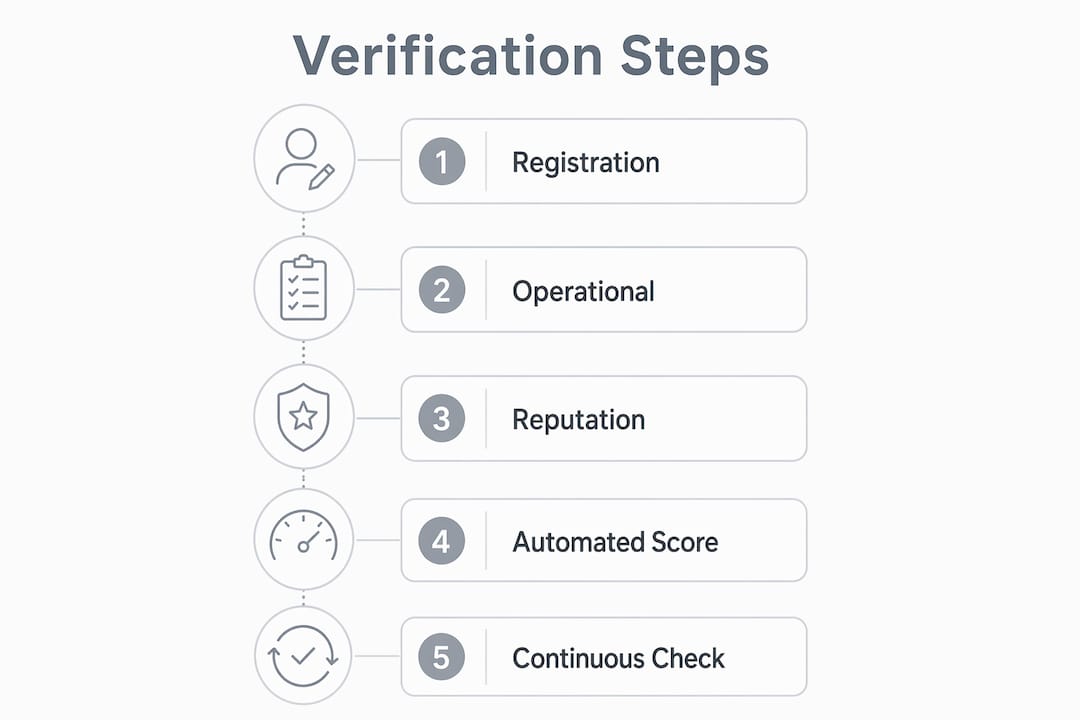
A credibility check answers three questions: Is the company legally registered? Does it operate as claimed? And do independent sources confirm its trustworthiness? Each question requires a different data source, which is why single-source checks routinely miss critical red flags.
Legal registration is the baseline. A company can have a polished website and five-star reviews while existing only on paper, or while registered in a jurisdiction that imposes zero transparency requirements. Confirming active status in an authoritative registry is the non-negotiable first step.

Operational history adds context. A company incorporated last month carrying a contract worth six figures is a different risk profile than one with a decade of filings, stable officers, and consistent addresses. Registry data captures this history in a structured, searchable format.
Independent reputation data is the third layer. Customer reviews, complaint records, and media coverage reveal how a company actually behaves, not just how it presents itself. Combining all three layers produces a corporate credibility review that holds up under scrutiny.
Which official registries confirm a company's legal status?
Official government registries are the authoritative starting point for any company background verification. The most widely used include:
- Companies House (UK): Free search by company name or number. Confirms active or dissolved status, incorporation date, registered address, directors, and Persons with Significant Control (PSC).
- SEC EDGAR (US): Covers publicly traded companies and investment vehicles. Confirms filings, financial disclosures, and enforcement actions.
- VIES VAT (EU): Validates VAT registration numbers across EU member states. A missing or invalid VAT number is a red flag for any European B2B transaction.
- GLEIF LEI Database: The Legal Entity Identifier system covers financial counterparties globally. An active LEI confirms a company has passed identity verification with an accredited issuer.
- INSEE SIRENE (France): The French national business register. Covers sole traders and corporations with SIRET and SIREN numbers.
Cross-referencing at least two registries reduces risk significantly. A company that appears in Companies House but carries an invalid VIES VAT number, for example, warrants immediate follow-up before any payment.
Pro Tip: Registry databases occasionally go offline for maintenance. Standard verification practice adjusts the trust score rather than returning a hard error during downtime, so a temporarily unavailable registry should not block your decision entirely. Flag it and recheck within 24 hours.
Ownership verification is becoming more rigorous. UK director identity checks via GOV.UK One Login become mandatory from november 2025 for directors and Persons with Significant Control. Unverified officers in a registry are now a formal red flag, not just an informal concern.
| Registry | Coverage | Key Data Points |
|---|---|---|
| Companies House | United Kingdom | Active status, directors, PSC, filings |
| SEC EDGAR | United States (public companies) | Financial disclosures, enforcement actions |
| VIES VAT | European Union | VAT number validity across member states |
| GLEIF LEI | Global (financial entities) | Legal entity identity, accredited verification |
| INSEE SIRENE | France | SIRET/SIREN numbers, business category |
How do automated trust scoring tools work?
Automated trust scoring tools cross-validate multiple global registries and return a unified result in minutes. Modern verification tools deliver a 0–100 trust score that flags shell company patterns and regulatory risks, with verdicts ranging from "Verified and Trustworthy" to "High Risk."
The 0–100 scale maps to letter grades. A score in the A+ range signals high confidence in legal standing, operational consistency, and clean compliance history. An F grade signals avoid, though it guides rather than replaces your own due diligence. Grades from A+ to F reflect regulatory data including FDA actions, payment-processor issues, and ownership uncertainty.
Shell company detection is one area where automated tools outperform manual searches. Detection algorithms identify suspicious patterns such as extreme name changes, zero director counts, and rapid multi-jurisdiction registrations. A human reviewer checking one registry at a time would rarely catch a company that registered in three jurisdictions within 90 days while cycling through four director names.
Cost is no longer a barrier. Automated verification can cost as little as $0.05 per company check, making frequent, scalable credibility checks viable for procurement teams of any size. Batch processing lets you screen an entire vendor list overnight rather than manually checking each supplier one by one.
Pro Tip: When reading a trust score, look at the component flags, not just the headline number. A score of 65 with a shell company flag is a very different risk than a score of 65 driven only by a thin review history.
How do you assess company reputation through independent reviews?
Star ratings alone do not measure trustworthiness. A composite reputation score blends star ratings at 60% weight and review sentiment at 40% weight, then applies penalties for scam complaints and refund disputes. That weighted approach produces a more reliable verdict than a raw average.
The leading platforms for reputation data are Trustpilot, the Better Business Bureau (BBB), and Google Business Profile. Each captures a different segment of customer experience. Trustpilot skews toward e-commerce and SaaS. The BBB captures formal complaints and resolution records. Google Business Profile reflects local and service-based businesses most accurately.
The "trust gap" phenomenon is the most underappreciated risk in business reputation assessment. High star ratings can mask billing disputes or refund clusters that only appear when you dig into complaint categories. A company with a 4.6-star average and 200 unresolved refund complaints is a worse risk than one with a 4.1-star average and a clean complaint record.
Vendor risk scoring formalizes this insight. Vendor risk scores incorporate trustworthiness, reputation, and deterioration factors to produce procurement verdicts coded green, yellow, or red. Procurement teams that use these tiers avoid the common mistake of approving a vendor based on a rating snapshot that is already six months out of date.
Key signals to watch when reviewing reputation data:
- A sudden drop in review volume after a period of high activity (possible review suppression or business decline)
- Clusters of one-star reviews mentioning the same specific issue (billing, delivery, or product safety)
- Owner responses that deflect rather than resolve complaints
- A high BBB complaint count relative to the company's size or age
- Positive reviews that use identical phrasing (a pattern associated with incentivized or fabricated reviews)
How to conduct a comprehensive company credibility check yourself
A thorough company trustworthiness evaluation follows a clear sequence. Skipping steps or reordering them leads to gaps that fraudulent companies exploit.
-
Confirm legal registration. Search the relevant national registry using the company's full legal name and any registration number they provide. Confirm the status is active, not dissolved or struck off.
-
Verify the registered address. Cross-check the address against Google Maps and the company's own website. A registered address that is a mail forwarding service in a high-risk jurisdiction is a warning sign.
-
Check officer and ownership records. Confirm that named directors appear in the registry and that beneficial ownership is disclosed. Combining registry data with sentiment analysis gives the most complete picture of trustworthiness.
-
Run an automated trust score. Use a platform that integrates multiple registries and returns a scored verdict. Note any flags for shell company patterns, regulatory actions, or ownership uncertainty.
-
Review independent reputation data. Check Trustpilot, BBB, and Google Business Profile. Look at complaint categories, not just star averages. Calculate the ratio of resolved to unresolved complaints.
-
Check for adverse media. A quick search combining the company name with terms like "fraud," "lawsuit," or "regulatory action" surfaces issues that registries and review platforms do not capture.
-
Interpret the combined picture. A company with a clean registry record, a trust score above 70, and a green vendor risk verdict is low risk. Any single red flag warrants deeper investigation before proceeding.
Pro Tip: Never rely on a company's own "About Us" page for verification data. Self-reported information is not evidence. Every claim needs a third-party source to count as verified.
Common mistakes to avoid: over-weighting a single five-star rating, skipping officer verification because the company is small, and treating a one-time check as permanent. Credibility scores should refresh every 4–6 hours in live systems. For your own checks, revisit any vendor or partner at least quarterly.
Key Takeaways
A company credibility check requires legal registry confirmation, automated trust scoring, and independent reputation analysis working together. No single source delivers a complete picture on its own.
| Point | Details |
|---|---|
| Start with official registries | Confirm active legal status in Companies House, SEC EDGAR, VIES VAT, or GLEIF before anything else. |
| Use automated trust scores | A 0–100 score from a multi-registry tool catches shell company patterns that manual checks miss. |
| Weight reputation carefully | Composite scores blending star ratings and sentiment are more reliable than raw averages alone. |
| Watch for the trust gap | High ratings can hide billing disputes and refund clusters. Always check complaint categories. |
| Treat checks as ongoing | Company risk changes fast. Revisit vendors quarterly and use platforms that update scores frequently. |
Why static checks are no longer enough
I have reviewed hundreds of vendor files over the years, and the single most common mistake I see is treating a credibility check as a one-time event. A company that passes every test in january can be in regulatory trouble by april. That is not a hypothetical. It happens with enough regularity that procurement teams who rely on annual reviews consistently absorb losses that quarterly checks would have prevented.
The shift toward live, frequently updated scoring is the most significant development in this field. When a trust score recalculates every few hours rather than every few months, you catch deterioration signals while there is still time to act. A sudden drop in a vendor's score, driven by a spike in refund complaints or a new regulatory filing, is exactly the kind of early warning that saves a contract relationship or prevents a bad payment.
What I find underappreciated is the human impact layer. Credibility frameworks that incorporate algorithmic fairness and product safety metrics reveal how a company treats its employees and customers, not just its financial health. A company can be financially solvent and still be a reputational liability. Those signals show up in sentiment data long before they appear in a balance sheet.
My practical advice: build the check into your workflow at the contract stage, not after. Run the registry search, pull the automated score, and review the reputation data before you sign anything. That sequence takes less than 30 minutes with the right tools. The cost of skipping it is always higher.
— Vittorio
Verifyproject: a global trust engine for company credibility
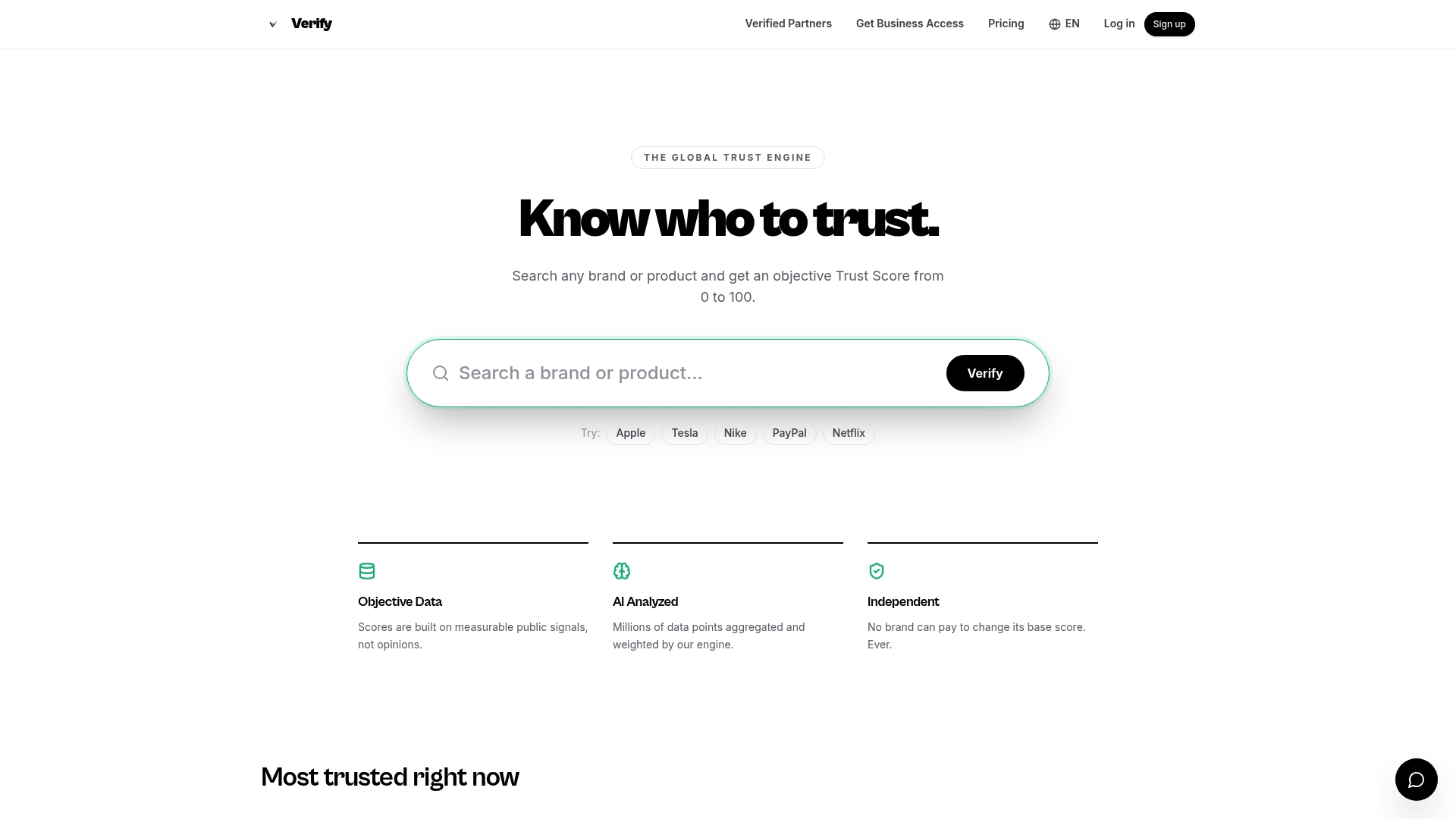
Verifyproject is built for exactly this kind of verification. Search any company name and receive an objective Trust Score from 0 to 100, derived from millions of public data points processed by AI. No company can pay to alter its base score. That independence is what makes the result useful. The Verify Certified badge gives verified businesses a visible signal of trustworthiness, while buyers and procurement teams get a clear, unbiased verdict before they commit. Companies like Apple and Microsoft score at the top of the range. Whether you are a consumer checking a new vendor or a business screening a supplier, Verifyproject delivers the kind of corporate credibility review that used to require a team of analysts.
FAQ
What is a company credibility check?
A company credibility check is the process of verifying a business's legal registration, operational history, and independent reputation before a transaction or partnership. It combines official registry searches, automated trust scoring, and review platform analysis.
How do I verify company legitimacy for free?
Search the relevant national registry such as Companies House, SEC EDGAR, or VIES VAT using the company's legal name or registration number. These databases are publicly accessible and confirm active status at no cost.
What is a trust score and how is it calculated?
A trust score is a 0–100 rating produced by cross-validating multiple registries and data sources through an automated system. Scores incorporate legal status, officer records, compliance history, and reputation signals, with letter grades from A+ to F guiding interpretation.
Can a high star rating mean a company is trustworthy?
Not necessarily. High star ratings can mask billing disputes and refund clusters, a pattern known as the trust gap. A composite reputation score that weights sentiment and penalizes complaint categories is a more reliable measure of trustworthiness.
How often should I run a business credibility assessment?
Run a full check before any new contract or significant purchase. For ongoing vendor relationships, revisit the assessment at least quarterly. Live scoring platforms that update every few hours provide the most current risk picture between formal reviews.